How to Draw a Pencil — Easy Step-by-Step Guide
Master the art of drawing a realistic pencil with this simple, step-by-step tutorial. Perfect for budding artists looking to hone their skills.
Quick answer
To draw a pencil, you need paper, a graphite pencil, and an eraser, taking about 20-30 minutes. Start by sketching the basic shape. This beginner-friendly activity has 10 steps and is perfect for families and kids aged 6+.
What you need
Shop on Amazon · As an Amazon Associate we earn from qualifying purchases. Links above are affiliate links — we may earn a commission at no extra cost to you.
Embark on a creative journey with this accessible guide to drawing a realistic pencil. This project is a fantastic starting point for anyone looking to explore the nuances of graphite art, offering a tangible subject that allows for focused practice on form, shading, and detail. It's particularly rewarding for beginners and young artists, providing a clear path to achieving impressive results with fundamental drawing techniques. The satisfaction of bringing a simple, everyday object to life on paper is immense, making this an engaging and confidence-building activity for all ages.
On this page
Step-by-Step Instructions
- 1
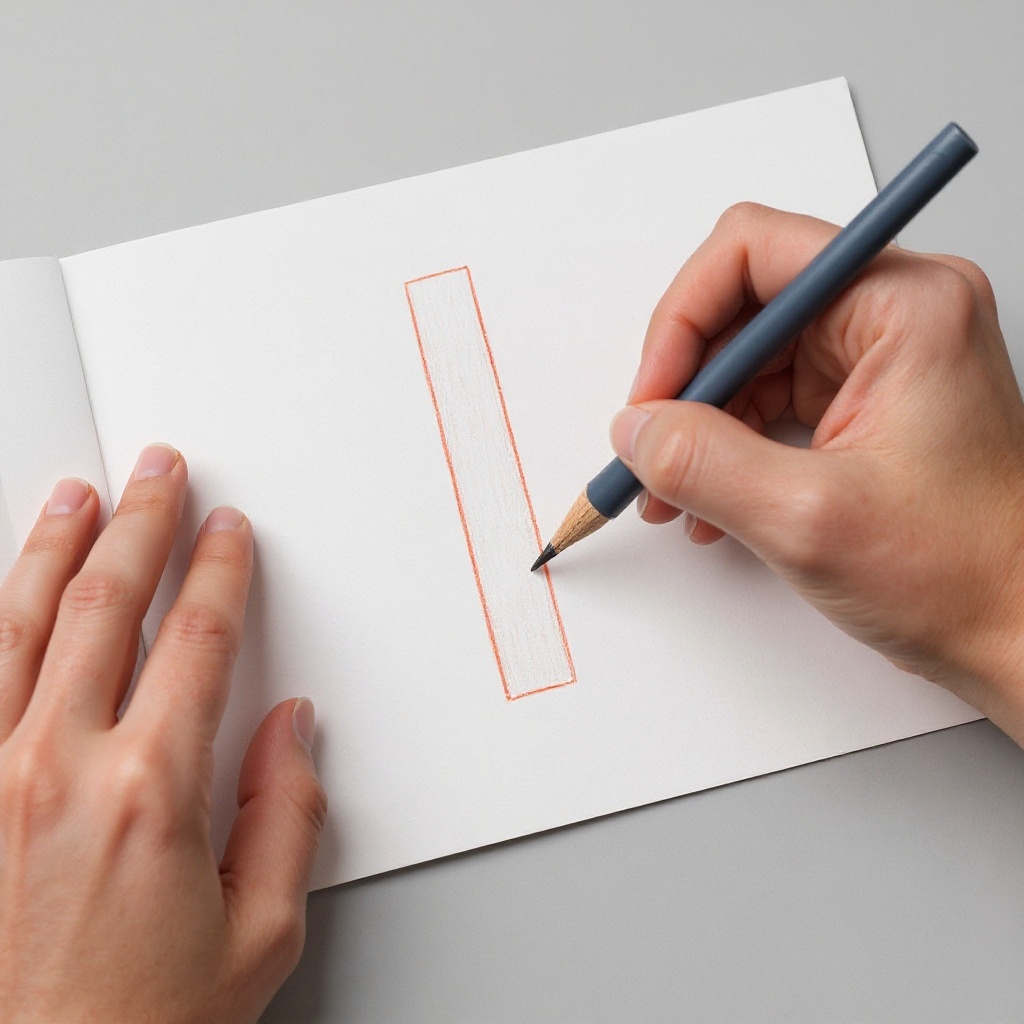
Lightly sketch a long, thin rectangle on your paper to represent the main body of the pencil. This will be your guide, so use a light touch with your HB pencil, ensuring the lines are easily erasable. Think of this as the central axis around which the rest of the pencil will be built.
- 2
At one end of the rectangle, draw a slightly wider, tapered shape to form the pencil's tip. This should resemble a cone or a sharp point, extending from the rectangle. Ensure the base of the cone connects smoothly to the end of your initial rectangle.
- 3
Add a small, curved line at the very tip of the cone to indicate the graphite lead. This small detail adds realism, suggesting the exposed core of the pencil. Keep this line subtle for now, as it will be darkened with shading later.
- 4
Draw a hexagonal shape around the tapered tip, extending a short way up the rectangle. This forms the sharpened wood casing of the pencil. Visualize the facets of a hexagon and draw them so they meet at the tip, creating a sense of sharpened wood.
- 5
At the other end of the rectangle, draw a smaller, slightly curved rectangle to represent the eraser holder, also known as the ferrule. This piece is typically metallic and cylindrical, so a slightly rounded rectangle will capture its form effectively.
- 6
Draw a small, rounded rectangle on top of the ferrule to depict the eraser itself. The eraser is usually slightly domed or has rounded edges, so avoid a sharp, straight line. Consider its texture and how it might be slightly worn.
- 7
Refine the main body of the pencil by drawing six lightly angled lines on each side of the initial rectangle to create the hexagonal barrel. These lines should extend from the ferrule end towards the tip, subtly angling inwards as they approach the sharpened section. This gives the pencil its characteristic hexagonal shape, which is crucial for realism.
- 8
Begin to refine the overall shape by gently connecting the lines of the hexagonal barrel to the ferrule and the base of the sharpened wood. Ensure smooth transitions between the different sections of the pencil, paying attention to any subtle curves or bulges that might exist on a real pencil.
- 9
Erase any overlapping construction lines that are no longer needed, focusing on the outer shape of the pencil. Carefully remove the initial rectangular guide and any internal lines that don't contribute to the final form. This step is crucial for cleaning up your drawing and defining the pencil's silhouette.
- 10
Now, begin to add depth with shading. Lightly shade the graphite lead area, making it darker than the rest of the pencil. Use your 2B pencil and apply even pressure, gradually building up the tone. Remember that the lead is a dark, matte material.
- 11
Add subtle shading to the hexagonal barrel and the eraser to give your drawing depth and dimension. Observe a real pencil to see where light would naturally fall and where shadows would be cast. Use your HB pencil for lighter tones and your 2B for darker areas, blending as needed.
- 12
Use your kneaded eraser to lift highlights from the hexagonal barrel and the ferrule. Gently press the eraser onto the shaded areas where light would reflect most strongly, such as along the edges of the hexagonal facets or on the metallic ferrule. This creates a sense of shine and form.
- 13
Further develop the shading on the hexagonal barrel by adding darker tones in the recessed areas between the facets and lighter tones on the edges that catch the light. You can use a blending stump or your finger to smooth out transitions for a more realistic effect.
- 14
Add a subtle shadow beneath the pencil itself to ground it on the paper. This shadow should be darker directly under the pencil and gradually fade outwards, indicating the direction of your light source.
- 15
Refine the eraser's shading. If it's a new eraser, it will have a smoother tone; if it's used, you might add subtle smudges or indentations. Use your kneaded eraser to lift highlights on the eraser's surface.
- 16
Examine your drawing critically. Look for areas that could benefit from more contrast, smoother transitions, or sharper details. Add final touches to the graphite lead, the ferrule, and the wood grain if desired, using your pencils and erasers to enhance realism.
Tips & Troubleshooting
- 1Don't press too hard with your pencil when sketching the initial shapes. Lighter lines are easier to erase and adjust, allowing for greater flexibility as you build your drawing. This is especially important for the initial construction lines.
- 2Experiment with different shading techniques to achieve varied textures and tones. You can use smooth, even shading for the ferrule, cross-hatching for darker areas, or stippling for subtle textures on the wood. Practice these techniques on scrap paper first.
- 3For a more realistic look, observe a real pencil closely. Notice where the light hits and where shadows fall, paying attention to the subtle reflections on the metallic ferrule and the matte finish of the wood and lead. Try to replicate these observations in your drawing.
- 4If you make a mistake, use your kneaded eraser to gently lift the graphite without damaging the paper. A standard eraser can be used for more precise corrections, but the kneaded eraser is excellent for subtle adjustments and creating soft highlights.
- 5Consider the light source when shading. Determine where the light is coming from and ensure your highlights and shadows are consistent with that direction. This consistency is key to creating a believable three-dimensional form.
- 6Build up your tones gradually. Instead of trying to achieve a dark shade in one go, layer your graphite pencil strokes slowly. This allows for more control and makes it easier to correct mistakes or adjust the intensity of the shading.
- 7Pay attention to the details of the ferrule. This metallic band often has subtle reflections and a slight sheen. Use your eraser to create these highlights and your pencil to define its cylindrical shape and any embossed markings.
- 8Don't be afraid to use a variety of pencil grades if you have them. An HB is great for initial sketching and lighter tones, while a 2B or even a 4B can be used for the darkest parts of the graphite lead and deep shadows, adding significant contrast.
Related Activities You Might Enjoy
Frequently Asked Questions
What are the best pencils for drawing a realistic pencil?
For drawing a realistic pencil, an HB or 2B graphite pencil is ideal. The HB pencil is excellent for initial sketching and light shading due to its balanced hardness and erasability, allowing for clean lines and subtle tonal variations. The 2B pencil, being softer, provides richer, darker tones which are perfect for the graphite lead, the ferrule, and creating deeper shadows, adding essential contrast and depth to your drawing. Having both allows for a good range of values, crucial for achieving realism. If you want even darker tones, a 4B or 6B pencil can be beneficial, but for a beginner, HB and 2B offer a fantastic starting point.
How do I make my pencil drawing look 3D?
To make your pencil drawing look 3D, focus heavily on shading and understanding light. Add darker tones in the areas where light would not reach, creating shadows, and use lighter tones or leave areas blank where the light source directly hits the pencil, creating highlights. Observe a real pencil to understand how light interacts with its form; notice the subtle curves of the hexagonal barrel, the shine on the metallic ferrule, and the matte finish of the wood and lead. The contrast between light and shadow, along with smooth transitions achieved through blending, will give your drawing a convincing sense of volume and depth.
What is the easiest way to draw a pencil?
The easiest way to draw a pencil is to start with simple geometric shapes. Begin by lightly sketching a long, thin rectangle for the main body. Then, add a cone shape at one end for the tip and a smaller, slightly rounded rectangle at the other for the eraser holder. Gradually refine these shapes by adding the hexagonal facets of the barrel and the details of the ferrule and eraser. Once the basic form is established, use shading techniques to add depth and realism. This step-by-step approach, breaking down the complex object into manageable shapes, makes it accessible even for absolute beginners.
Can I draw a colored pencil instead of a graphite one?
Yes, you can absolutely draw a colored pencil! The basic shapes and shading principles remain the same, but you'll be using colored pencils for the entire drawing instead of graphite. You would start with the same geometric construction lines and then use various shades of colored pencils to build up the color and form of the pencil. For instance, you might use browns and yellows for the wooden barrel, silver or gold for the ferrule, and a dark gray or black for the lead. The key is to observe the specific colors and subtle variations present in a colored pencil and replicate them through layering and blending your colored pencils.
What are the essential tools for drawing a realistic pencil?
The essential tools for drawing a realistic pencil are a good quality drawing paper, a graphite pencil (an HB for sketching and light shading, and a 2B or darker for contrast), and at least two types of erasers. A kneaded eraser is invaluable for lifting highlights and making subtle corrections without damaging the paper's surface, while a standard pink or white vinyl eraser is useful for more decisive removal of construction lines. A pencil sharpener is also crucial to maintain a sharp point for detailed work. Optional but highly recommended tools include blending stumps or tortillons for smooth shading transitions and a chamois cloth for broader blending.
How long does it typically take to draw a realistic pencil?
The time it takes to draw a realistic pencil can vary significantly based on your skill level, the desired level of detail, and the amount of time you dedicate to each step. For a beginner following this guide, a reasonable estimate would be between 30 minutes to an hour. This allows ample time for sketching, refining shapes, and applying basic shading. More experienced artists aiming for a highly detailed and photorealistic finish might spend several hours on a single pencil drawing, meticulously layering tones, blending, and adding subtle textures. The key is not to rush, but to enjoy the process of observation and rendering.
What Next?
Congratulations on completing your realistic pencil drawing! You've successfully captured the essence of this everyday tool. To further enhance your skills, consider drawing other stationery items like pens, erasers, or sharpeners, applying the same principles of form and shading. You could also experiment with different types of pencils, such as colored pencils, to explore vibrant hues. Once your masterpiece is complete, you can frame it to adorn your workspace or gift it to a fellow art enthusiast. Remember to store your drawings away from direct sunlight to preserve their quality.
Free: 10 Paper Crafts Anyone Can Make in 5 Minutes
Get our beginner guide + new craft ideas weekly.
No spam. Unsubscribe anytime.
Did you complete this activity?